The self is a general term that is subjective as there are multiple approaches on how to define it and will vary from person to person. One can go about the self as to how one is being perceived by others or how one perceives oneself. Additionally, it can also be that the self is evident in the minute details of a person such as his/her actions, ideas, behavior, and other aspects. Regardless of how one defines the self, it is known, felt, and believed that the self is inherent, unique, and dynamic. Essentially, one’s self belongs to him/her alone and is continually developing with his/her interactions with the environment.
In order to better understand the self, the concepts discussed, both the bioecological theory of human development and the globalization of the world, must be synthesized and applied.
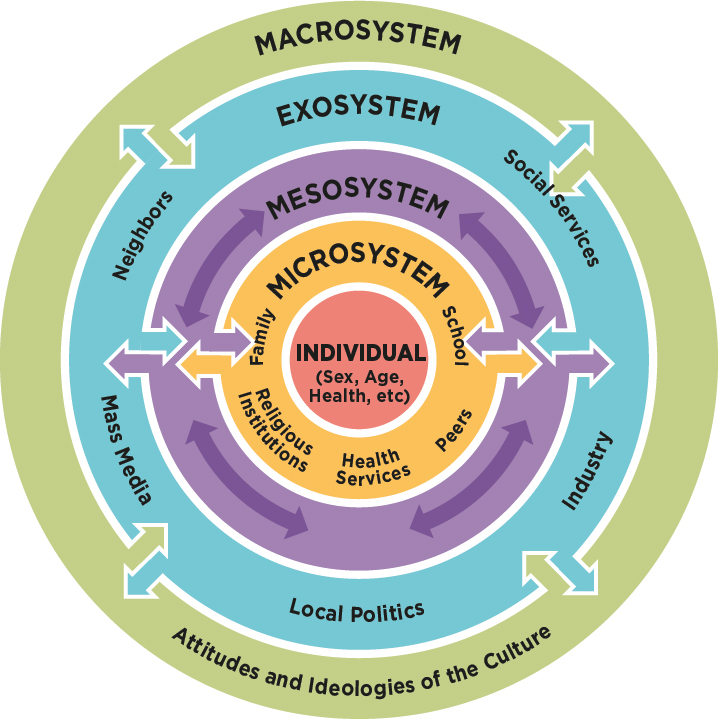
The bioecological theory of human development essentially posits that the development of the self is influenced by the interrelations of the self and the environment through the concepts of Process, Person, Context, and Time. Just to briefly explain each concept, process is the most important concept as this encapsulates the activities and interactions between the individuals and the environment crucial to one’s development; person is concerned with the individual personal characteristics—demand, resource, and force—that sets the context for how other people will perceive the individual; context is subdivided into four interrelated systems—microsystem, mesosystem, ecosystem, and macrosystem—that sets where and how interactions occur; finally, time is also subdivided into three types—micro-time, meso-time, and macro-time—that connects the other concepts in terms of relative constancy and change.
The globalization of the world serves to increase the interconnectedness of the people from various parts of the world with one another through the Internet, the media, or the act of traveling itself. With this, the transmission of ideas, meanings, and values of various cultural groups becomes prevalent, bringing along with it both positive such as the creation of a hybrid identity and negative effects such as identity confusion to one’s self. Essentially, being open to the advances of globalization can help further shape one’s self so as long as he/she can maintain balance between his/her global self, developed in relation to outside of one’s immediate environment of family, friends, and relatives, and local self, developed in relation to one’s immediate environment of family, friends, and relatives.
The concept of proximal process fascinated me the most as it is mainly the building block in the development of one’s self. Proximal processes’ effect on the development of one’s self is affected by the characteristics of the developing person, the environment, and the developmental outcomes over time. Essentially, one must take note of these characteristics as these pave the way for rich and meaningful interactions. Through interacting with my immediate environment of family, friends, and relatives or even myself on a regular basis, I am able to not only develop my sense of self but also the other party’s sense of self as well. As I interact consistently with my immediate environment and as long as it is reciprocated, our interactions become progressively more complex which serves as a gateway for the higher integration of one’s self.
With the globalization in the world, being able to know and distinguish one’s local and global self may help solidify and maintain one’s current self or form a hybrid self to accommodate both selves.
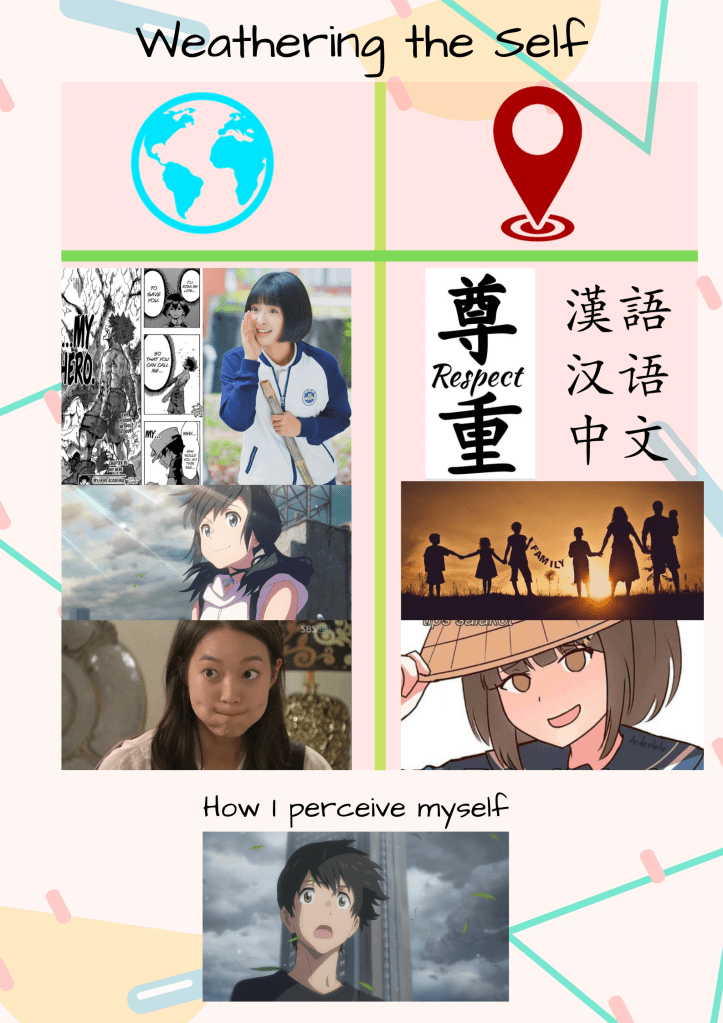
Global self is the gateway to fostering a sense of belonging with the rest of humankind, both part of and outside of one’s immediate environment of family, friends, and relatives. The current popular culture has a more dominant role in establishing one’s global identity. Hereby, my interests in manga, anime, and Korean or Chinese dramas help me connect better with other people. Although all these forms of entertainment are from various countries, each and every one of them was able to showcase a large part of their culture.
Local self, on the other hand, is the gateway to one’s inner sense of self. This consists of mainly the specific values, traits, practices, and languages or the traditional culture that is slowly developed within the person once he/she was born unto the world. Most of my sense of self is based on the fact that I grew up in a Filipino-Chinese community. With this in mind, my main sense of local self is evident in the values of respect and being family-oriented and the three languages of Chinese, English, and Filipino that I grew up with.
Being both a Filipino-Chinese and an avid lover of anime, manga, Chinese dramas, and Korean dramas, I, simply being myself, am a hybrid self.
Although people have various interests and ways of maintaining their own sense of self, all of us undergo the same process of doing so through interactions with one another, which in itself fosters a sense of belonging with the rest of humankind.
As most theories and concepts are mainly theoretical, these must be applied in one’s life in order to further make sense of it. The best way to do so is through engaging in interactions with one’s immediate environment. Additionally, being open to other’s cultures helps one relate with other people which increases one’s circle of interactions, thus increases one’s outlet to develop the self.
We all are continually exploring ourselves. We are growing with each and every interaction we engage in. We are in a lifelong commitment to understand and develop our selves.

 Jacob's Journey